
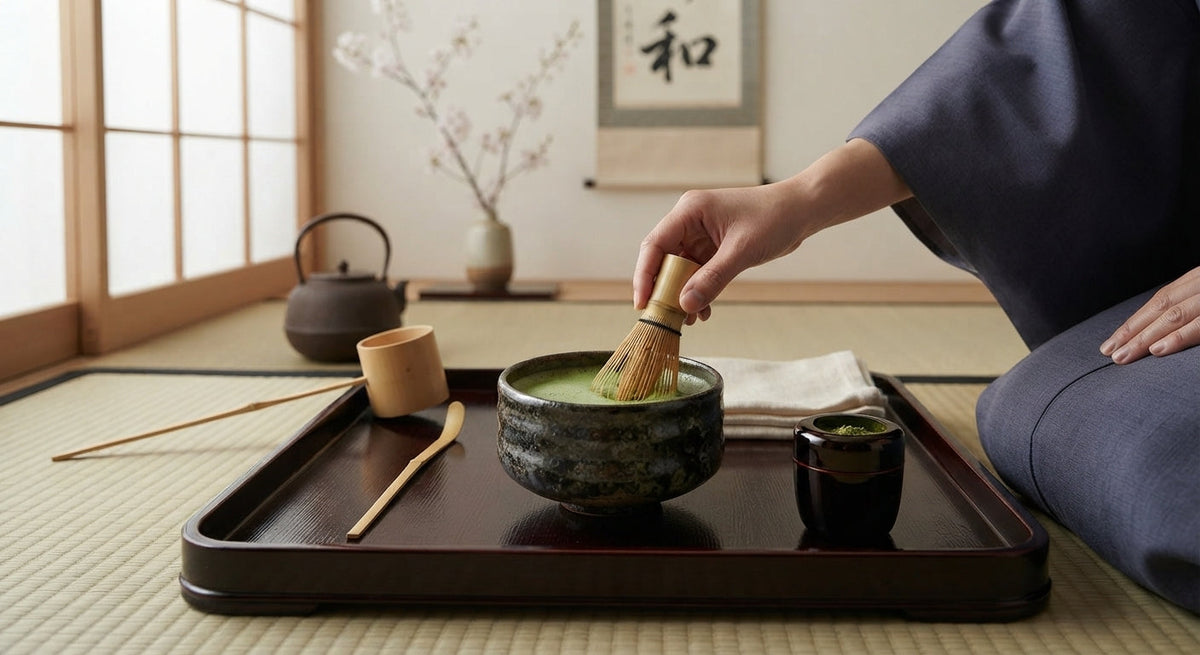
Chadō, the Japanese 'way of tea', is about more than the drink itself. Preparation, respect for guests and time spent together all play an important role. Matcha is at the heart of a culture in which even simple actions are carried out with care.
How matcha is prepared and enjoyed is an essential part of this tradition. Traditional Japanese Chadō distinguishes two main forms of preparation: Usucha (thin tea) and Koicha (thick tea).
2. What is the difference between Usucha and Koicha?
Usucha (薄茶) and Koicha (濃茶) are two traditional ways of preparing matcha. They differ mainly in consistency, the ratio of powder to water and the preparation method.
Usucha – thinner tea
Usucha uses relatively more water and less matcha. It is whisked briskly with a Chasen, a bamboo whisk, to create a fine layer of foam. It is lighter and often feels fresher and more airy.
As a rough guide, use about 2 g of matcha with 60–80 ml of water.
Koicha – thick tea
Koicha contains considerably more matcha relative to water. Rather than whisking vigorously to create foam, the powder and water are stirred slowly and gently until the mixture is smooth and thick.
A rough guide is about 3–4 g of matcha with 30–40 ml of water. Exact amounts depend on the matcha variety and the tea school, among other factors.
Koicha is traditionally served in particular tea ceremony settings and is often shared by several guests from the same bowl. Usucha is also part of traditional tea ceremonies and appears in different forms of tea practice.
3. The history of Chadō: from Chinese Diancha to Japanese tea culture
The roots of Japanese matcha culture extend, among other influences, to China's Song dynasty. In the Diancha (点茶) practice of that time, powdered tea was mixed with hot water and whisked with a suitable tool.
Over time, these tea traditions reached Japan and developed independently there. Different tea masters shaped Japanese tea culture, particularly from the 15th and 16th centuries. Sen no Rikyū played an important role in developing the aesthetics of Chadō, which remain influential today.
Over several centuries, a distinct tradition emerged in which preparing and sharing tea became closely connected with hospitality, mindfulness and appreciation.
4. The four guiding principles of Chadō
Japanese tea tradition is often described through four terms associated with Sen no Rikyū:
Wa – harmony (和)
Wa describes harmony between people and their surroundings. The shared tea experience should be shaped by balance and consideration for others.
Kei – respect (敬)
Kei means showing appreciation for other people, the objects being used and the shared moment.
Sei – purity (清)
Sei refers to the cleanliness of the space and utensils, as well as a clear and attentive attitude during tea preparation.
Jaku – inner tranquillity (寂)
Jaku describes an inner tranquillity that can grow from practising the other three principles. The aim is not to force calm, but to let it develop through attentive participation in the way of tea.
Together, these four principles show that Chadō is more than a preparation technique. They describe an attitude towards tea, other people and the present moment.
5. What happens during a tea ceremony?
The exact sequence varies with the tea school, occasion and type of ceremony. However, some general steps can be described:
- Preparation: The tea room and required utensils are prepared before the guests are welcomed.
- Cleaning the utensils: The tea utensils are cleaned or carefully arranged according to the particular tradition.
- Preparing the matcha: Matcha is mixed with hot water and, depending on the desired form, whisked as Usucha or gently stirred as Koicha.
- Serving and enjoying: The tea is offered to guests, who receive and drink it according to the customs of the particular tea school.
Each action is part of the tradition. Its meaning lies not only in correct execution, but also in the attention that hosts and guests give one another.
6. Chadō in modern daily life
Today, not every bowl of matcha needs to be part of a formal tea ceremony. In Japan and around the world, matcha is enjoyed in many ways: plain, as a latte or in other modern creations.
A connection with traditional tea culture is still possible. Taking time to prepare matcha carefully and notice its flavour draws on an idea that also matters in Chadō: appreciating the present moment.
Tradition and daily life need not exclude one another. This connection is also reflected in Zenma's matcha sets . Our traditional set invites you to prepare matcha with classic utensils and take time over the process. The Express Set is designed for anyone who wants to make matcha an easy, flexible part of everyday life.
Whether you choose traditional preparation or a practical alternative for use on the go, both let you enjoy matcha in your own way. Preparation methods can change while appreciation for the tea and its quality remains.
7. Zenma Matcha: tradition for today
At Zenma, we see matcha as a connection between cultural heritage and modern life. Our approach is Modern Heritage: appreciating the tradition behind matcha and bringing it into daily life in a way that feels natural and contemporary.
The name Zenma also draws on 'Zen', a concept associated with calm, concentration and awareness. This does not mean making every cup into a ritual. We want to create space to discover matcha in your own way, whether as Usucha, as a latte or simply as a mindful pause in your day.
Tradition need not remain unchanged to live on. With Zenma, we want to preserve the depth of matcha culture and make it accessible in a way that suits modern life.