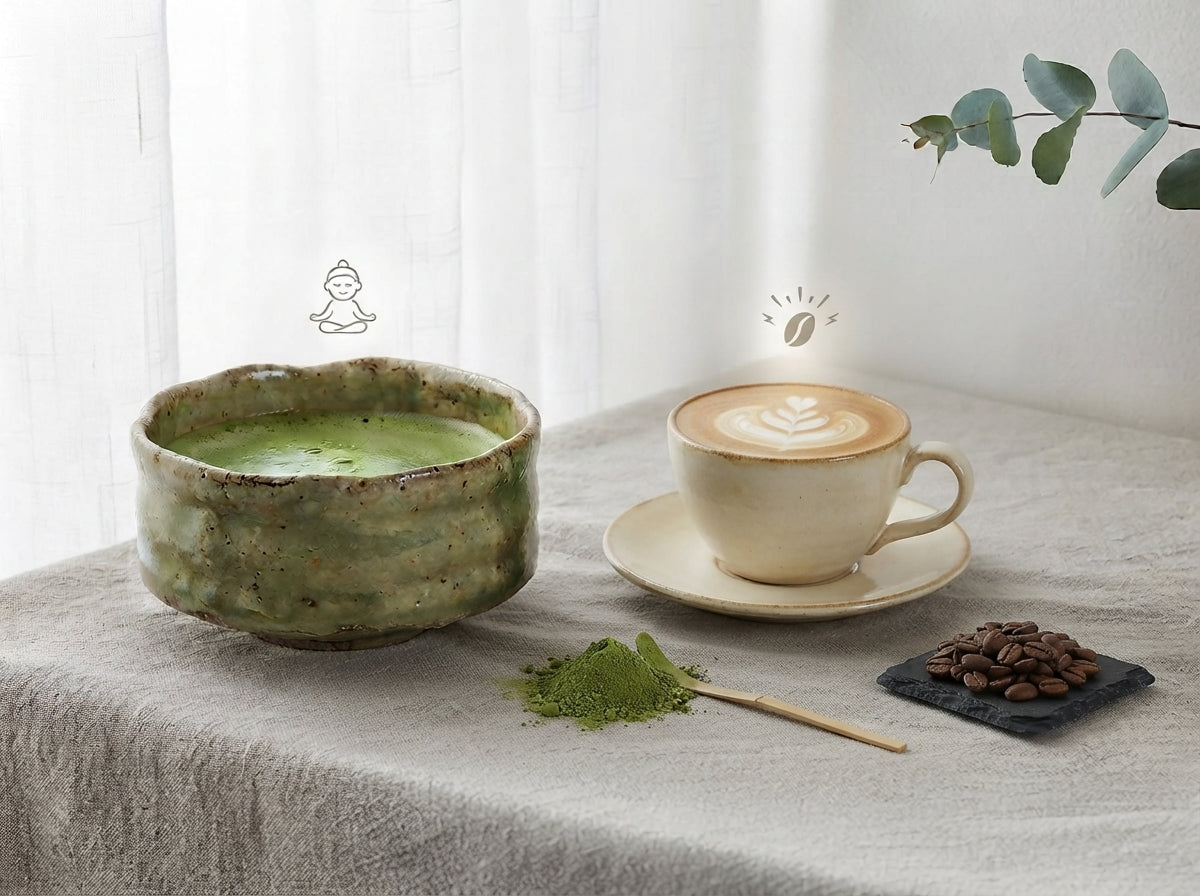
Matcha is a popular alternative to coffee, whether as traditional tea, a creamy latte or refreshing iced matcha. How much caffeine does a serving contain? Does it have more or less caffeine than coffee, and what affects its caffeine content?
This mainly depends on how much powder you use and its caffeine concentration. Here is how to assess the caffeine in your serving.
How much caffeine is in 2 g, 3 g or 4 g of matcha?
For our LÁN Matcha we have a supplier analysis reporting a caffeine content of 3,6 % . The following estimates can be calculated on that basis, provided the percentage refers to the weight of the powder as supplied:
| LÁN quantity | Calculated caffeine content |
|---|---|
| 2 g of matcha | approximately 72 mg |
| 3 g of matcha | approximately 108 mg |
| 4 g of matcha | approximately 144 mg |
These figures are calculated estimates based on the supplier's specification, not separately measured values for prepared drinks. They apply only if the 3.6% figure refers to the powder's weight as supplied rather than its dry matter. The analysis basis still needs confirmation.
Powder quantity matters: even one extra gram can noticeably increase the caffeine consumed.
How much caffeine does matcha contain in general?
Matcha naturally contains caffeine. Unlike ordinary brewed green tea, matcha is consumed as finely ground tea leaf, including its caffeine.
The caffeine in your cup depends on both the powder's concentration and the amount used. Values therefore vary by product and preparation.
In 2024, the Bavarian State Office for Health and Food Safety (LGL) examined 47 matcha and green tea products. Sample caffeine concentrations ranged from 1.4 to 3.6 g per 100 g of dry matter. Drinks prepared with 1–2 g of matcha powder contained approximately 13–68 mg of caffeine.
The study illustrates differences between products. Its results cannot simply be applied to every matcha.
Source: Bavarian State Office for Health and Food Safety – investigation of matcha tea
Matcha or coffee: which contains more caffeine?
Both matcha and coffee can provide significant caffeine. A direct comparison is meaningful only when serving sizes are considered.
The European Food Safety Authority (EFSA) gives the following approximate examples:
| Drink | Example serving | Caffeine |
|---|---|---|
| Espresso | 60 ml | approximately 80 mg |
| Filter coffee | 200 ml | approximately 90 mg |
| Black tea | 220 ml | approximately 50 mg |
Source: EFSA – caffeine
On the basis of the analysis, a 2 g serving of LÁN calculates to approximately 72 mg of caffeine, comparable with an espresso (approximately 80 mg), provided the stated analysis basis applies.
Why does matcha's caffeine content vary?
Not every matcha contains the same amount of caffeine. Several factors can affect its composition.
The tea plant and cultivar
Different plants and cultivars can develop different amounts of caffeine and other constituents.
Cultivation and harvest
Growing conditions and harvest time can also affect tea leaf composition. Shading is an important part of matcha production and influences various plant constituents.
The amount used
This is an especially easy factor to control. Using more powder increases caffeine intake if the caffeine concentration per gram remains the same.
L-theanine and caffeine: what makes matcha distinctive?
Besides caffeine, matcha contains L-theanine, an amino acid naturally found in tea leaves. Caffeine can promote alertness, while L-theanine is being studied in relation to attention and concentration. Their interaction is of interest, but does not guarantee sustained concentration or freedom from nervousness.
The supplier analysis for LÁN reports 3.6% caffeine and 1.5% L-theanine.
How much matcha can I drink in a day?
EFSA states that, for healthy adults, single doses up to 200 mg of caffeine and daily intake up to 400 mg do not raise safety concerns. The daily reference for pregnant or breastfeeding people is 200 mg. Even 100 mg may affect some people's sleep, particularly near bedtime. These values cover caffeine from all sources and are not intake targets.
Assuming a caffeine content of 3.6%, the equivalent LÁN quantities calculate as follows:
| EFSA reference | Approximate equivalent LÁN quantity | Meaning |
|---|---|---|
| 200 mg in a single dose | 5.6 g | Reference for healthy adults |
| 400 mg per day | 11.1 g | Total daily caffeine intake |
| 100 mg | 2.8 g | May affect some people's sleep |
| 200 mg per day | 5.6 g | Daily reference for pregnancy and breastfeeding |
Important: LÁN figures are calculated reference values, not recommended quantities to drink. EFSA values cover caffeine from all sources, including coffee, tea and chocolate. The conversion assumes that 3.6% refers to the original powder weight.
Source: EFSA – caffeine
How much matcha powder should I use for a latte?
The amount depends on your taste and desired caffeine content.
-
2 g: for a lighter matcha flavour
-
3 g: for a more intense tea aroma
-
4 g: for a stronger matcha flavour and correspondingly more caffeine
These are starting points. Your actual caffeine intake depends on the caffeine concentration of the particular matcha.
How much caffeine does matcha contain?
Depending on the product and amount used, matcha can contain similar caffeine to coffee. For LÁN, a stated concentration of 3.6% calculates to approximately 72 mg per 2 g of powder, provided the percentage refers to the original powder weight.
Explore the products: NAGI Matcha · LÁN Matcha.