
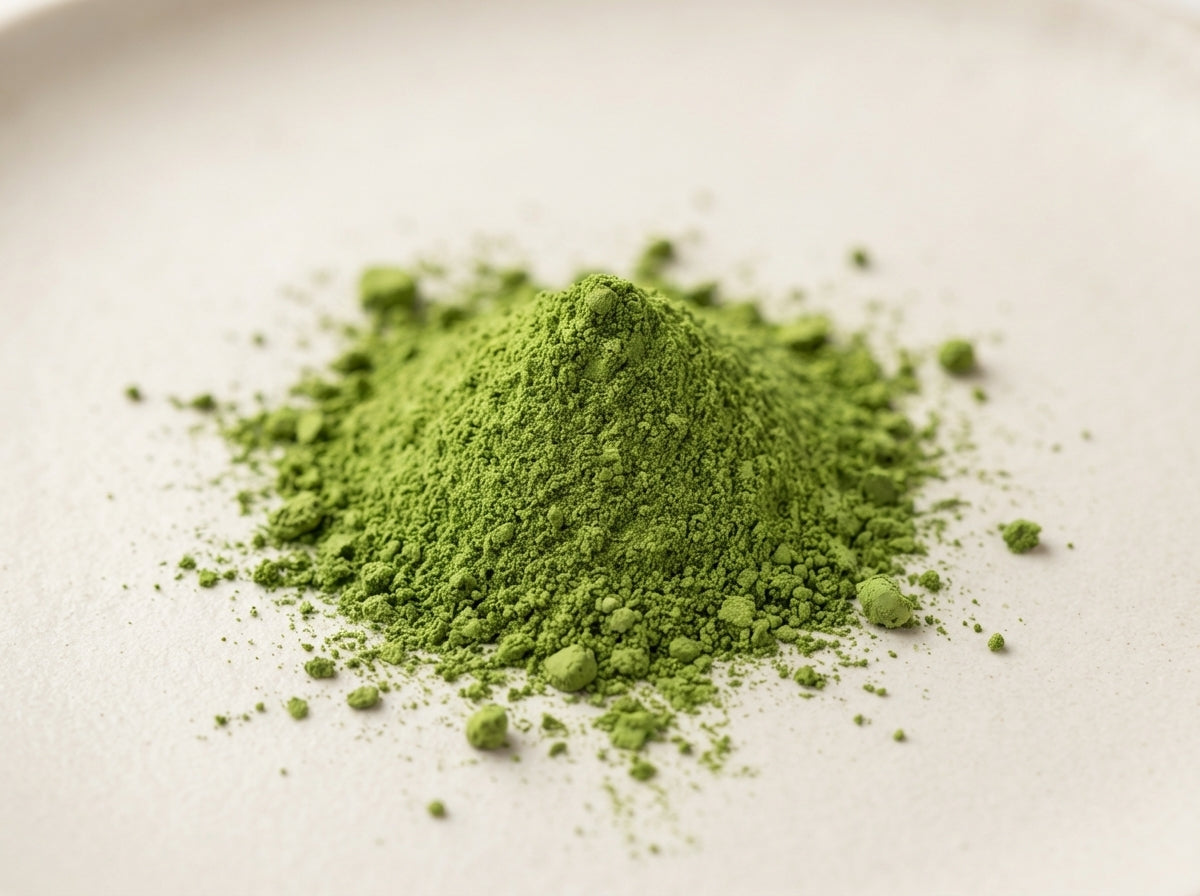
What is matcha made from?
Matcha is a finely ground green tea powder made from specially processed tea leaves. Its history connects the Chinese tradition of powdered tea with the tea culture that later developed in Japan. Today, matcha is enjoyed in many ways, from traditionally whisked tea to a modern matcha latte.
This matcha guide explains how matcha is made, how varied its flavours can be, what it contains and how it differs from ordinary green tea. We also show you what to consider when choosing matcha and which type might suit your taste.
Contents
-
What is matcha and how is it made?
-
What does matcha taste like?
-
Matcha or green tea: what is the difference?
-
How can you recognise good matcha?
-
Matcha, caffeine, L-theanine and health
-
Matcha and Japanese tea culture
-
Which matcha suits you?
What is matcha and how is it made?
Matcha is a finely ground powder made from specially processed green tea. Unlike loose-leaf green tea, we do not drink only an infusion: the powder is whisked with water and consumed along with it.
Production begins in the tea garden. For traditional matcha, tea plants are shaded for a period before harvest. Shading affects the leaves' metabolism and, among other things, their colour, aroma and flavour.
After harvest, the fresh leaves are steamed to stop enzymatic oxidation and largely preserve their green colour. They are then dried and sorted, with stems and veins removed. This produces Tencha – the raw material used to make matcha. Finally, the Tencha is ground into a fine powder.

How matcha is made:
Tea plants in the tea garden
↓
Shading before harvest
↓
Harvesting the tea leaves
↓
Steaming
↓
Drying and sorting into Tencha
↓
Fine grinding
↓
Matcha powder
What makes matcha distinctive is not simply grinding green tea into powder. Leaf selection, processing and Tencha production also matter. The grinding method influences the powder's fineness and mouthfeel.
What does matcha taste like?
Matcha does not have just one flavour profile. Tea variety, growing region, harvest time and cultivation method can produce substantial differences. Combining different varieties, known as blending, can also create a particular flavour profile and consistent balance.
Some matcha varieties have a pronounced umami note. Umami is often described as a savoury, full-bodied taste, familiar from foods such as broth or mushrooms. It is not matcha's only characteristic, nor is it equally strong in every variety.
Other varieties may taste more floral, nutty, creamy or fresh. Some have more pronounced vegetal notes or bitterness. These differences do not automatically make one variety better than another; they show how varied matcha can be.
Besides the first impression, pay attention to the finish: does the tea feel fresh and light, or full-bodied and rounded? Is its bitterness pleasantly balanced? Does a sweet note or delicate tea aroma remain after drinking?
Preparation also changes the flavour experience. Water temperature, water quantity, dosage and whisking technique all influence the result. Milk and plant-based alternatives can soften bitterness but can also mask delicate aromas. Our comparison explores which option may suit your matcha: Matcha with Oatly or milk?.
These differences make discovering different matcha varieties particularly interesting.
Matcha or green tea: what is the difference?
Matcha and other green teas come from the same plant species, Camellia sinensis. However, this does not mean the same cultivars or processing methods are used everywhere.
Japan and China both have long traditions of tea cultivation. Growing regions differ in climate, soil, elevation and cultivation methods. Over generations, tea farmers and breeding programmes have selected and developed cultivars to suit regional conditions and desired tea characteristics.
The main difference between matcha and ordinary loose-leaf green tea is processing and preparation:
-
Matcha: For traditional matcha, shaded Tencha leaves are steamed, dried, sorted and finely ground. The powder is consumed when you drink it.
-
Loose-leaf green tea: The leaves are normally infused in hot water and then removed from the drink.
Matcha and other green teas therefore differ not only in form, but also in how they are grown, processed and consumed.
How can you recognise good matcha?
Matcha quality cannot be judged by colour or a label alone. Colour, aroma, flavour, texture and transparent product information together provide a fuller picture.
Colour
Good matcha often has a vibrant green colour. The precise shade depends on variety, shading, processing and storage, among other factors. Colour is a useful clue, but not proof of quality on its own.
Aroma
When you open the pack, the tea should have a clear, natural aroma. Depending on the variety, it may be fresh, vegetal, floral, nutty or full-bodied. Noticeably stale or unpleasant smells can indicate quality or storage problems.
Flavour and finish
Notice how bitterness, sweetness, umami and other flavours work together. Bitterness is not automatically a sign of poor quality. What matters is a balanced overall profile and a pleasant finish.
Texture and particle size
Matcha is finely ground, but particle size depends on the milling technology and grinding conditions, among other factors. Different processes can produce finer or coarser particles.
Particle size can affect how fine the powder feels in the mouth and how well it disperses in water during whisking. On its own, it does not tell you how high-quality a matcha is or how it tastes.
Origin and product information
Information about origin, cultivar and processing can help you understand a matcha. Transparent product information makes it easier to trace where the tea comes from and how it was made. Origin and variety provide useful clues, but do not guarantee a particular flavour profile.
'Ceremonial Grade' is not a globally uniform, binding standard either. Rather than relying on a grade name alone, consider both product information and flavour.
Our article explains what Ceremonial Matcha means and how to interpret common grade labels.
Packaging and storage
Matcha is sensitive to light, air, moisture and heat. Tightly sealed, light-protective packaging and suitable storage after opening help preserve colour and aroma.
Matcha, caffeine, L-theanine and health
Matcha naturally contains caffeine, L-theanine and polyphenols. Unlike brewed tea, whose leaves are removed, drinking matcha means consuming the tea powder itself, along with the substances it contains.
Caffeine: alertness and attention
Caffeine is a natural component of tea. It promotes alertness and can reduce tiredness. The caffeine in a serving of matcha depends on the amount of powder used and the particular variety, among other factors.
L-theanine: a naturally occurring amino acid
L-theanine is an amino acid naturally present in tea leaves. Its effects, including possible interactions with caffeine, are being studied. Drinking matcha does not guarantee relaxation or improved concentration.
Polyphenols and catechins: natural plant compounds
Matcha contains polyphenols, including catechins such as EGCG (epigallocatechin gallate). These compounds are being studied for their antioxidant properties, including possible associations with metabolic and cardiovascular functions. Evidence about compounds does not establish a health benefit from drinking a particular matcha product.
What does this mean in everyday life?
Matcha combines caffeine with other naturally occurring substances. As with coffee and other caffeinated drinks, portion size and individual tolerance matter when making it part of your routine.
Read more about caffeine in matcha and the role of serving size in our article How much caffeine does matcha contain?.
Matcha and Japanese tea culture
Matcha's history is closely linked to Japanese tea culture, but extends to older tea traditions in East Asia.
During China's Song dynasty, processing tea into powder and whisking it with water was widespread. This method later reached Japan and developed within its own cultural and historical setting. Over time, a distinct Japanese matcha and tea culture emerged.
Matcha's history therefore cannot be reduced to a single invention or an unchanged adoption. It connects early Chinese traditions with independent developments in tea cultivation, processing and culture in Japan.
In the Japanese tea ceremony, Chadō, matcha is more than a drink. Preparation is connected with hospitality, attention, the arrangement of space and the considered use of bowls and other utensils.
You do not need to perform a complete tea ceremony to enjoy matcha in everyday life. Traditionally prepared tea and matcha latte are among many ways to discover it.
Which matcha suits you?
Choosing matcha is mainly about your taste and how you plan to prepare it.
If you prefer a fresh, mild profile with less bitterness, choose a variety with those characteristics. If you often drink matcha with milk and want a pronounced tea flavour, a stronger flavour profile may suit you better.
At Zenma, NAGI and LÁN have different emphases:
-
NAGI: Less bitter, with a fresher, milder character in milk. Its delicate matcha notes can become less noticeable when combined with milk.
-
LÁN: Slightly more bitter than NAGI. Its matcha flavour remains more pronounced when combined with milk.
This does not mean one variety is inherently better. Either can be the right choice depending on your taste and preparation.
If you are unsure, our comparison NAGI or LÁN? Which matcha suits you? can help you understand the differences.
Ultimately, choose a matcha that suits your taste and daily life. Our comparison can help you understand the differences between the varieties.
Explore the products: NAGI Matcha · LÁN Matcha.